

What AI Is Actually Changing in Real Estate (and What It Isn't)
The Agent Is Still the Product
Want updates on course launches, AI tool recommendations, and what we're building?
Drop your email!
Holly came across a brokerage marketing itself as an AI brokerage. Fully automated, tech-first, the future of the industry. So she did what anyone would do and started clicking around the site.
"Do you know what's most prominent on their site? Humans. The pictures and bios of agents in that brokerage, with the number of years they've been in the business and how many transactions they've closed."
Holly Priestner
That is worth sitting with. The most aggressively AI-forward players in real estate lead with the same thing everyone else leads with: people who have done this before. They are not hiding the agent behind the technology. They are using the technology to sell the agent.
AI is changing how the work gets done. It is not changing who does it.
We Have Been Here Before
This is not the first time the industry has been told technology is about to make agents unnecessary.
"It reminds me of the inflection point when iBuying platforms first emerged. The disruption occurred, but not by removing the real estate agent. Actually, quite the opposite. The technology changes at that time resulted in more informed consumers, and informed consumers demand working with a more highly skilled real estate agent."
Holly Priestner
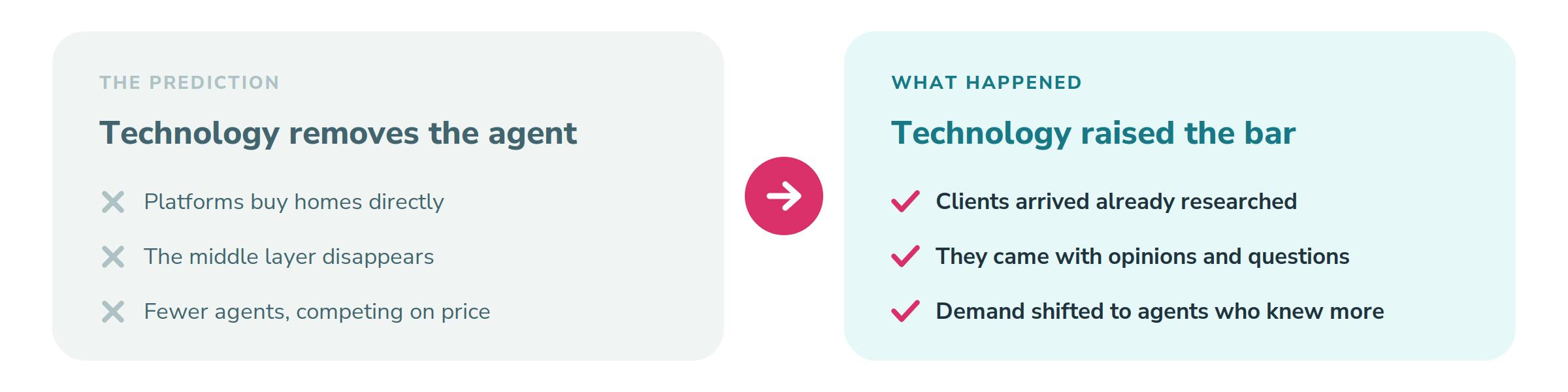
The disruption was real. It just landed somewhere other than where everyone was looking.
The same pattern is running again. AI is making buyers and sellers smarter before they ever call you. They have already researched neighborhoods, compared comps, and read up on where the market is heading. They arrive with opinions.
What they need on the other end of that conversation is not a search engine with a license. They need someone who knows things AI does not, who can read the room, and who has earned the right to be trusted with the biggest purchase of their life.
The Curve Everyone Rides
Across both of our companies, we have watched people move through the same four stages with AI, in the same order, almost without exception.

Nobody skips a stage. The only real question is whether you stop at the third one.
Stage three is where the drop-off happens. Someone tries a tool, gets back something generic or plainly wrong, and concludes the whole category is overhyped. That conclusion feels earned, because the output really was bad.
But the output was bad for a reason that has nothing to do with the tool. It is almost always the prompt, and that is a fixable problem.
The agents who push past stage three do not get there by being more technical than everyone else. They get there by being willing to stay curious a little longer.
What It Actually Takes Off Your Plate
The part that surprises people is which work disappears first. It is not the interesting work.
"It takes away the work you don't want to do. Half the time you spend drafting emails, doing follow-ups, making lists, you now have tools to automate that busy work. And now you can think more thoughtfully about strategy, about what your client actually needs and how to meet that as a human."
Holly Priestner
Nobody got into real estate because they loved writing follow-up emails. What is being automated is the administrative layer that sits between you and the actual job. For a concrete look at how that plays out across an ordinary working day, see Article 3.
A better-informed client needs a better agent.
Aceable's continuing education is built around the market knowledge and judgment that clients arrive with higher expectations for.
The Gap Is Smaller Than It Looks
A real difference is opening up between agents who have built AI into their practice and those who have not. It is worth being honest about that.
It is also worth being accurate about how big it is: still small enough to close. The agents who are ahead did not get there with talent or a bigger tech budget. They got there with practice, and practice is available to everyone.
Change is uncomfortable, and this is a real change. Give yourself permission to feel that, and then ask the next question anyway: okay, where do I start?
Start with the foundation. Whether you are newly licensed or a decade in, the thing that makes every AI tool more useful is knowing your market well enough to catch it when it is wrong. That is what continuing education and Fast Track are for. Not licensed yet? Start there.
Then read the AI Capability Pyramid and find your tier.